

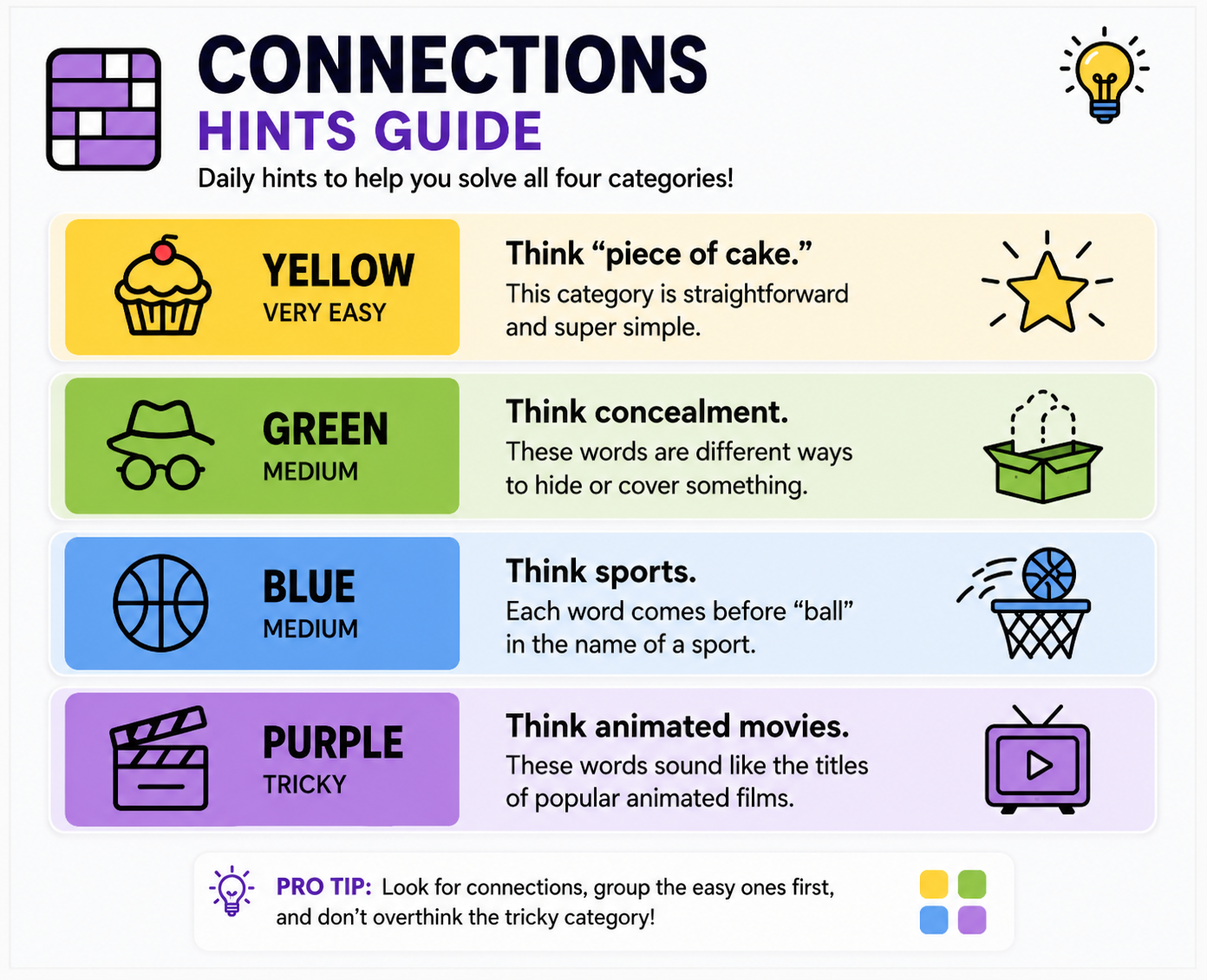
NYT Connections Hints Today is one of the most popular daily word puzzles for players who enjoy testing their vocabulary, pattern recognition, and problem-solving skills. The puzzle gives you 16 words and challenges you to divide them into four groups of four, with each group sharing a hidden connection.
It sounds simple, but Connections can be surprisingly difficult. Some words can appear to fit into multiple categories, while others are deliberately placed to create misleading connections.
If you’re looking for help with the current puzzle, visit our NYT Connections Hints Today page for the latest daily clues, hints, categories, and answers.
This guide explains how NYT Connections works, what the different difficulty levels mean, how to use hints effectively, and the strategies that can help you solve puzzles faster.
What Is NYT Connections?
NYT Connections is a daily word association puzzle published by The New York Times.
Each puzzle contains 16 words. Your goal is to organize those words into four groups of four, with every group sharing a specific connection.
The connections can be based on almost anything, including:
- Similar meanings
- Common phrases
- Names
- Places
- Food
- Movies and television
- Sports
- Technology
- Brands
- Abbreviations
- Wordplay
- Words that can follow another word
- Words that can come before another word
The challenge is that the intended connection is not always obvious.
NYT Connections at a Glance
| Feature | Details |
|---|---|
| Puzzle Type | Daily word association puzzle |
| Words Per Puzzle | 16 |
| Number of Groups | 4 |
| Words Per Group | 4 |
| Difficulty Levels | Yellow, Green, Blue, Purple |
| Main Objective | Find four groups of related words |
| Main Challenge | Avoid misleading connections |
| New Puzzle | Released daily |
How Does NYT Connections Work?
When you open a Connections puzzle, you are presented with a grid containing 16 words.
You need to select four words that you believe share a common connection.
If your selection is correct, those four words are removed from the board and their category is revealed.
You then continue with the remaining words until you have found all four groups.
However, there is an important catch.
Some words can logically belong to more than one possible group. This is intentional.
For example, a word could be related to a particular object while also being part of a common phrase. The puzzle wants you to recognize the intended connection, not simply find any relationship.
What Do the NYT Connections Colors Mean?
Each Connections category has a color representing its relative difficulty.
| Color | Difficulty | Typical Connection |
|---|---|---|
| 🟨 Yellow | Easiest | Common and fairly obvious relationship |
| 🟩 Green | Moderate | Requires some thought or recognition |
| 🟦 Blue | Difficult | Less obvious connection |
| 🟪 Purple | Hardest | Often involves wordplay or an unusual relationship |
The colors can help you understand how difficult a group is expected to be.
However, difficulty is subjective. A category that seems obvious to one player may be the hardest group for another.
How to Solve NYT Connections
The best way to approach Connections is to avoid immediately trying random combinations.
Instead, work through the board systematically.
1. Scan All 16 Words
Start by reading every word before selecting anything.
Look for obvious similarities.
Ask yourself:
- Do several words belong to the same category?
- Are there obvious names?
- Do several words form familiar phrases?
- Are there words with similar meanings?
- Can multiple words be preceded or followed by the same word?
This first scan can reveal potential groups.
2. Find the Most Obvious Group
Once you identify a strong connection, focus on it.
Ideally, you want to find four words that clearly belong together.
Do not settle for a category simply because four words technically fit.
Connections frequently uses red herrings, so the strongest and most specific connection is usually the better choice.
3. Look for Alternative Meanings
This is one of the most important Connections strategies.
A word may have multiple meanings.
For example, a word could be:
- A common noun
- A verb
- A person’s name
- A brand
- Part of a phrase
- A title
- An abbreviation
If a word seems to fit two different groups, stop and reconsider the surrounding words.
The puzzle may be using that word specifically to mislead you.
4. Think About Common Phrases
Not every connection is based on meaning.
Sometimes the words become connected when combined with another word.
Ask:
Can the same word go before or after all four words?
This is particularly useful when solving the harder blue and purple categories.
5. Look for Proper Nouns
Don’t assume every word is being used as an ordinary dictionary word.
Connections may involve:
- First names
- Last names
- Cities
- Countries
- Companies
- Brands
- Characters
- Movies
- TV shows
- Sports figures
If several words suddenly look like names or titles, investigate that possibility.
6. Use Elimination
Once one group is solved, the remaining board becomes easier.
You now have only 12 words to consider.
After solving another group, you are left with eight.
Then four.
This is why solving even one obvious category can dramatically change the puzzle.
The Best NYT Connections Strategy
A good solving strategy can be summarized in the following steps:
| Step | Strategy | Why It Works |
|---|---|---|
| 1 | Read all 16 words | Gives you the complete picture |
| 2 | Look for obvious relationships | Helps identify easy groups |
| 3 | Search for specific categories | Reduces false connections |
| 4 | Check multiple meanings | Prevents common traps |
| 5 | Consider phrases | Helps with wordplay categories |
| 6 | Look for names and titles | Finds less obvious connections |
| 7 | Solve the strongest group | Removes four words |
| 8 | Use elimination | Simplifies the remaining board |
| 9 | Use a hint if stuck | Provides direction |
| 10 | Check the answers | Confirms your solution |
Common NYT Connections Traps
Connections is designed to make players second-guess themselves.
Understanding the most common traps can make you a much better solver.
Broad Categories
One of the biggest mistakes is creating a category that is too broad.
You may find four words that are all technically related to food, sports, technology, or another general topic.
That does not necessarily mean they form a valid group.
Look for a specific connection rather than a general relationship.
Words With Multiple Meanings
A single word may appear to belong to several groups.
This is often deliberate.
Before submitting a group, ask whether one of your words has another possible interpretation.
False Four-Word Groups
Sometimes you will find four words that seem perfect together.
Then you discover that one word actually belongs somewhere else.
If a group feels suspiciously easy, examine it carefully before committing.
Similar Spelling
Words can also look connected because of their spelling.
But Connections may be using their meaning rather than their spelling.
Always consider both possibilities.
How to Use NYT Connections Hints
You do not have to reveal the answers immediately when you get stuck.
Using hints progressively can make the puzzle more enjoyable.
Start With a General Hint
A general hint can tell you what type of category you are looking for without revealing the four words.
For example:
These words are associated with something you might find in a kitchen.
You still have to identify the words yourself.
Use a Stronger Hint
If the general clue does not help, move to a more specific hint.
This gives you enough information to recognize the intended connection while preserving some of the challenge.
Reveal the Answers Last
If you still cannot solve the group, checking the answers can help you understand the connection.
This is especially useful because seeing the completed category can teach you how the puzzle creators use ambiguity and wordplay.
For the current puzzle, you can visit NYT Connections Hints Today to get the latest clues and answers.
How to Get Better at NYT Connections
The best way to improve is to learn from the puzzles you have already played.
After solving a difficult puzzle, think about:
- Which category did you find first?
- Which group was the hardest?
- Which word caused confusion?
- Did you fall for a red herring?
- Was the connection based on meaning or wordplay?
- Could one word have multiple meanings?
Doing this regularly helps you recognize common puzzle patterns.
Over time, you will become faster at identifying possible groups and spotting misleading words.
Should You Use NYT Connections Hints?
Absolutely.
Hints can be useful when you want assistance without completely spoiling the puzzle.
A good approach is:
Solve first → use a general hint → try again → use a stronger clue → reveal the answer if necessary.
This allows you to maintain the challenge while still getting help when you need it.
If you play Connections every day, using hints can also help you learn how different categories are constructed.
NYT Connections vs Other Word Puzzles
Connections is different from many traditional word games because the answer is not based on a single word.
Instead, you have to discover relationships between multiple words.
| Puzzle Feature | NYT Connections |
|---|---|
| Words Shown | 16 |
| Groups | 4 |
| Words in Each Group | 4 |
| Main Skill | Pattern recognition |
| Common Challenge | Misleading connections |
| Wordplay | Frequently used |
| Strategy | Grouping + elimination |
| Difficulty | Changes depending on category |
This combination makes Connections particularly satisfying for players who enjoy puzzles that require lateral thinking.
Daily NYT Connections Hints and Answers
If you are looking for today’s specific puzzle, you do not need to search through old puzzle guides.
Our NYT Connections Hints Today page is updated with the latest daily puzzle, including its date, clues, categories, and answers.
That page is best for players who want immediate help with the puzzle they are solving today.
This guide, meanwhile, is designed to remain useful regardless of the puzzle date.
More Connections Guides
If you enjoy Connections and want to explore more puzzle-related content, check out our Forbes Connections guide for another useful resource on Connections-style puzzles and strategies.
You can also return to this guide whenever you need a refresher on solving techniques.
NYT Connections Frequently Asked Questions
How many words are in NYT Connections?
Every standard NYT Connections puzzle contains 16 words. You must divide them into four groups containing four words each.
How many groups are there in Connections?
There are four groups in every puzzle. Each group contains four connected words.
What do the yellow, green, blue, and purple colors mean?
The colors represent the approximate difficulty of each category. Yellow is generally the easiest, while purple is usually the most difficult.
What is the hardest Connections category?
Purple is generally considered the hardest category because it often involves wordplay, unusual meanings, or less obvious relationships.
What is the best way to solve Connections?
Start with the most obvious connection, avoid overly broad categories, consider multiple meanings, look for phrases and proper nouns, and use elimination after solving each group.
Can I use hints without spoiling the answers?
Yes. Start with a general clue and gradually move toward more specific hints. This lets you continue solving without immediately seeing the complete answers.
Where can I find today’s NYT Connections hints?
Visit our NYT Connections Hints Today page for the latest daily puzzle, clues, hints, and answers.
Final NYT Connections Tips
NYT Connections becomes much easier once you stop looking at the 16 words as individual answers and start looking for relationships between them.
Remember these key strategies:
- Scan the entire board before guessing.
- Find the strongest connection first.
- Avoid categories that are too broad.
- Watch for words with multiple meanings.
- Look for common phrases and word combinations.
- Consider names, brands, titles, and places.
- Use elimination after solving each group.
- Use hints when you are genuinely stuck.
- Learn from the categories you missed.
- Don’t be afraid to rethink a group that feels too obvious.
For help with the current NYT Connections puzzle, visit NYT Connections Hints Today for the latest clues and answers.
And if you want to explore more Connections-related content, check out our Forbes Connections guide.
