

Reviewed by RIC Guide editorial team
There are plenty of reasons to open Google Search, but playing a game usually isn’t one of them.
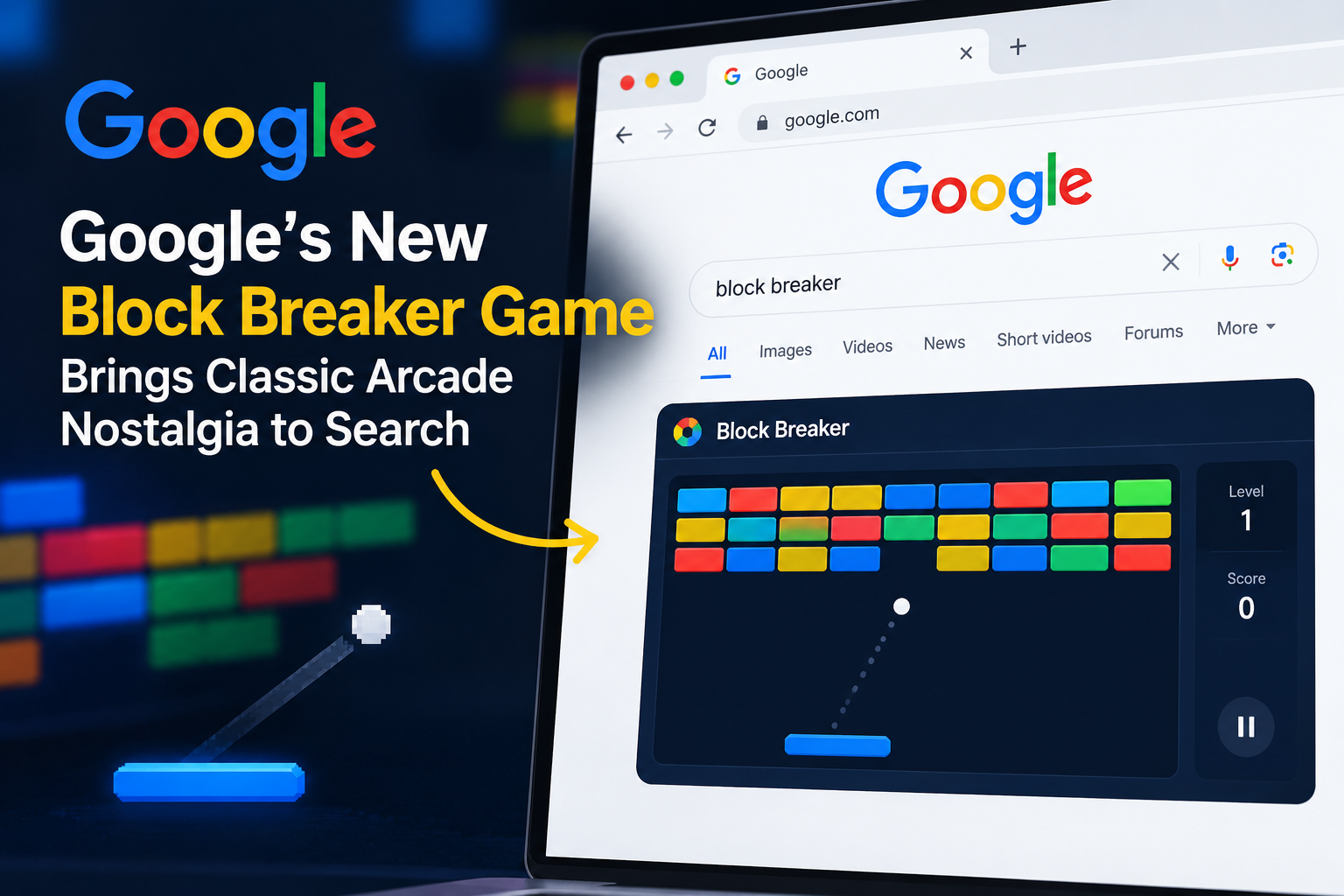
That changed when I came across the Block Breaker Game in Google Search.
It took only a few seconds to understand what I was looking at: a paddle, a bouncing ball and a screen filled with blocks. There was no complicated tutorial, no account to create and nothing to download. Just a familiar arcade concept presented directly inside Google Search.
I expected to play for a few minutes and move on.
Instead, I kept playing.
How to Play the Block Breaker Game
Getting started is straightforward. Search for “block breaker” on Google, and the playable experience may appear directly in the results.
From there, the objective is simple. Control the paddle at the bottom of the screen and keep the ball from falling while using it to break the blocks above.
The concept will feel immediately familiar to anyone who has played classic Breakout-style arcade games. Google has essentially taken that familiar formula and placed it somewhere most people wouldn’t expect: the search page.
You can try searching for block breaker on Google.
There is no lengthy setup process, which is a big part of the appeal. You can go from searching to playing almost instantly.
A Simple Concept That Still Works
Block-breaking games are hardly new. Atari’s original Breakout arrived in 1976 and helped establish the basic formula that countless games would later build upon.
The Block Breaker Game doesn’t attempt to reinvent that formula.
Instead, it focuses on what made the original concept work in the first place.
The controls are easy to understand, the objective is immediately clear and each successful hit gives you a small sense of progress. As the ball moves around the screen, the challenge comes from anticipating where it will land and positioning the paddle in time.
It is simple, but not mindless.
Once the pace increases, even a familiar game can demand more attention than expected.
The Nostalgia Is Part of the Appeal
What makes Google’s Block Breaker particularly enjoyable is how quickly it evokes the feeling of classic arcade games.
The experience doesn’t require modern gaming hardware or a lengthy commitment. It captures the basic rhythm of an old arcade title: start playing immediately, improve your score and try again when you eventually lose.
That simplicity feels refreshing.
Modern games often come with extensive tutorials, progression systems and increasingly complicated mechanics. Block Breaker strips all of that away.
You don’t have to learn a world or understand a character’s backstory.
You simply have to keep the ball in play.
And that simplicity is surprisingly effective.
Why the Block Breaker Game Is So Addictive
The appeal of the Block Breaker game comes from how quickly it gets you into the action. There is no complicated tutorial or long setup. You simply start playing and immediately understand what you need to do.
The gameplay is also built around small moments of progress. Every time the ball breaks another block, you get closer to clearing the screen. As the pace picks up, keeping the ball in play becomes more challenging, which makes each successful hit feel more rewarding.
The simplicity also makes it easy to keep playing. You can finish a round in a few minutes, but there is always a reason to try again and improve your performance.
That combination of simple controls, quick feedback and familiar arcade gameplay is what makes the Block Breaker game surprisingly difficult to put down.
Power-Ups Add Some Variety
The experience also goes beyond the most basic version of Breakout.
Power-ups can change the way a round develops, giving the player different advantages and making the gameplay less predictable. Some can affect the size of the paddle, while others can introduce additional balls into play.
The latter can make things considerably more chaotic.
With multiple balls moving around the screen, keeping track of everything becomes much harder. What starts as a relaxed few minutes can quickly turn into a focused attempt to keep the round alive.
That additional variety gives the game more replay value than a straightforward block-breaking clone might otherwise have.
Why It Is So Easy to Keep Playing
The most effective thing about Block Breaker may be its lack of friction.
There is no installation process, no sign-up and no commitment. You can discover it while searching for something completely unrelated and start playing almost immediately.
That makes it an ideal example of the kind of small interactive feature that works particularly well inside Search.
You might open Google intending to look something up, notice the game, play one round and then decide to try again.
The cycle is familiar because it has been part of arcade gaming for decades.
The difference is that this time the arcade machine is sitting inside your browser.
Google Gets the Formula Right
Google Search has included various games, interactive features and Easter eggs over the years, but Block Breaker stands out because the underlying gameplay is genuinely easy to understand.
It doesn’t try to be a full gaming experience.
That is precisely why it works.
The game is better viewed as a quick distraction than a replacement for a dedicated arcade or mobile title. Its strength is that you can access it with almost no effort and immediately understand what you’re supposed to do.
For anyone who remembers spending time with simple arcade games, that familiarity is likely to be the biggest attraction.
Final Verdict
Google’s Block Breaker is not a groundbreaking new game, and it doesn’t need to be.
Its appeal comes from something much simpler: it takes a classic arcade formula and makes it instantly accessible through Google Search.
The combination of straightforward controls, familiar gameplay and power-ups makes it an enjoyable way to spend a few spare minutes. More importantly, it demonstrates why simple games can still be remarkably engaging when they remove everything that gets between the player and the fun.
If you’re curious, search “block breaker” on Google and give it a try.
Just don’t be surprised if that quick five-minute break turns into another round.
