

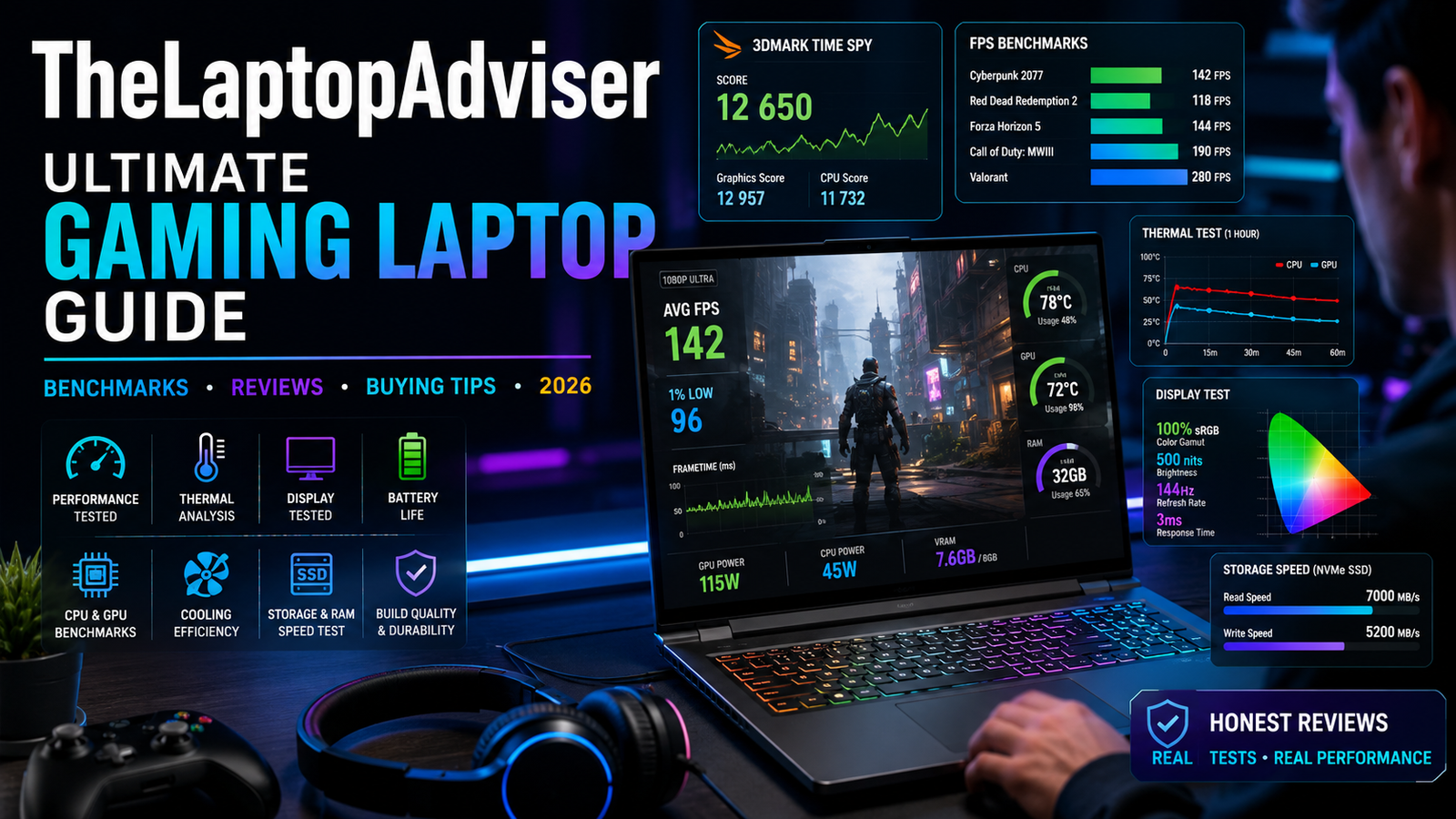
Buying a gaming laptop in 2026 is no longer as simple as choosing the newest processor or graphics card. Two laptops with identical specifications can deliver completely different gaming experiences due to differences in cooling systems, power limits, BIOS optimization, display quality, and overall engineering. That’s why independent review platforms have become an essential part of the buying process.
TheLaptopAdviser has gained recognition among gamers, students, content creators, and PC enthusiasts by focusing on practical testing rather than relying solely on manufacturer specifications. Instead of repeating marketing claims, the platform evaluates gaming laptops through hands-on benchmarks, thermal testing, battery analysis, display quality assessments, and real-world gaming performance.
Whether you’re shopping for your first gaming laptop or upgrading to a high-end machine, understanding how a review website performs its evaluations can help you make a more informed purchase.
In this comprehensive guide, we’ll explain TheLaptopAdviser’s review methodology, gaming benchmarks, laptop categories, testing standards, buying recommendations, and whether it’s a trustworthy resource for gamers in 2026.
TheLaptopAdviser at a Glance
| Category | Details |
|---|---|
| Website | TheLaptopAdviser |
| Primary Focus | Gaming Laptop Reviews |
| Content Type | Reviews, Buying Guides & Benchmarks |
| Best For | Gamers, Students & Content Creators |
| Review Style | Hands-on Testing |
| Gaming Benchmarks | Yes |
| Thermal Analysis | Yes |
| Battery Testing | Yes |
| Display Reviews | Yes |
| Buying Advice | Included |
What Is TheLaptopAdviser?
TheLaptopAdviser is a technology-focused review platform dedicated to helping buyers make smarter gaming laptop decisions through practical testing and detailed analysis. Rather than relying only on the specifications provided by manufacturers, the platform examines how laptops perform during actual gaming sessions, productivity workloads, and everyday use.
As gaming hardware becomes more advanced, comparing laptops based only on CPU and GPU models is no longer enough. Two systems equipped with the same graphics card can produce noticeably different frame rates depending on cooling efficiency, power allocation, memory configuration, and firmware optimization.
TheLaptopAdviser aims to bridge this gap by reviewing laptops from a user-first perspective. Instead of asking, “What hardware does this laptop have?“, the platform focuses on more practical questions:
- How smoothly does it run modern games?
- Does it maintain performance during long gaming sessions?
- How loud are the cooling fans?
- Is the display suitable for competitive gaming?
- Can the RAM and storage be upgraded later?
- Does it provide good value for the price?
This approach makes the website useful not only for experienced PC enthusiasts but also for beginners who want clear and reliable buying guidance.
💡 Quick Insight
A laptop’s specifications tell you what’s inside, but hands-on testing reveals how well those components actually work together during real-world gaming.
Why Gamers Follow TheLaptopAdviser
Every year, manufacturers launch dozens of gaming laptops featuring impressive marketing claims, RGB lighting, high refresh-rate displays, and powerful GPUs. However, experienced gamers know that specifications alone rarely tell the complete story.
This is one of the main reasons many buyers turn to TheLaptopAdviser before making a purchase.
The platform focuses on performance that users can actually experience instead of relying solely on promotional material. Rather than emphasizing only processor names or graphics card models, it evaluates how the complete system performs under real gaming conditions.
Why Readers Trust Detailed Reviews
| Feature | Why It Matters |
|---|---|
| 🎮 Gaming FPS Tests | Shows actual game performance |
| 🌡 Thermal Analysis | Detects overheating and throttling |
| 🔋 Battery Evaluation | Measures real battery endurance |
| 🖥 Display Testing | Reviews brightness, color, and refresh rate |
| 🔊 Fan Noise Analysis | Evaluates comfort during long gaming sessions |
| 🛠 Upgradeability | Helps buyers plan future upgrades |
These practical insights allow readers to compare laptops beyond their specifications and understand how they will perform during everyday use.
How TheLaptopAdviser Reviews Gaming Laptops in 2026
One of the strongest aspects of any technology review website is its testing methodology. Without consistent testing procedures, comparing different laptops becomes difficult because every review may use different conditions.
TheLaptopAdviser focuses on standardized testing so that readers can compare multiple gaming laptops fairly.
Instead of relying on synthetic numbers alone, reviews combine benchmark results with practical gaming sessions, productivity testing, thermal monitoring, and usability evaluations. This balanced approach helps buyers understand both peak performance and long-term reliability.
Hands-On Testing Instead of Marketing Claims
Manufacturer specifications provide useful information, but they don’t always reflect everyday performance.
Hands-on testing allows reviewers to verify whether a laptop performs as advertised under real workloads.
During practical testing, reviewers typically evaluate:
- Gaming performance across different genres.
- System responsiveness.
- Cooling efficiency.
- Build quality.
- User experience during extended sessions.
This approach gives buyers a clearer picture of what they can expect after purchasing the laptop.
Standardized Benchmarking Methodology
Consistency is essential when comparing gaming laptops.
A standardized benchmark process ensures that every laptop is tested under similar conditions, making comparisons more meaningful.
Typical Benchmark Checklist
| Benchmark Category | Purpose |
|---|---|
| CPU Benchmarks | Processing performance |
| GPU Benchmarks | Graphics capability |
| Gaming FPS Tests | Real-world gameplay |
| Productivity Tests | Content creation workloads |
| Battery Testing | Portable performance |
| Thermal Monitoring | Heat management |
Real-World Gaming Performance Tests
Benchmark scores are useful, but they only tell part of the story. What most gamers actually care about is how a laptop performs while playing real games over extended periods. A laptop that delivers excellent synthetic benchmark numbers may still struggle if it overheats, throttles performance, or produces inconsistent frame rates during long gaming sessions.
TheLaptopAdviser appears to emphasize real-world gaming tests that reflect the experience buyers can expect after purchasing a laptop. Instead of focusing on a single game, reviews typically cover multiple gaming genres to evaluate how the hardware performs under different workloads.
Games commonly used for performance evaluation often include:
- Competitive esports titles
- Modern AAA games
- Open-world RPGs
- Racing games
- Ray-tracing supported titles
This balanced testing methodology helps readers understand how a laptop performs across a wide range of gaming scenarios rather than relying on isolated benchmark numbers.
🎮 Expert Tip
Never judge a gaming laptop by one benchmark alone. Consistent performance across multiple games provides a much better indication of real-world gaming quality.
Thermal Performance Under Heavy Loads
One of the biggest reasons gaming laptops perform differently despite having similar hardware is thermal management.
As processors and graphics cards generate heat, the cooling system must remove that heat efficiently. If temperatures become too high, the laptop automatically reduces clock speeds to protect internal components. This process is known as thermal throttling, and it directly affects gaming performance.
A thorough review therefore looks beyond maximum FPS and examines how the laptop behaves after playing demanding games for 30 to 60 minutes.
Cooling Evaluation Checklist
| Cooling Factor | Why It Matters |
|---|---|
| CPU Temperature | Prevents processor throttling |
| GPU Temperature | Maintains graphics performance |
| Surface Temperature | User comfort |
| Airflow Design | Efficient cooling |
| Heat Distribution | Long gaming stability |
Gaming laptops with well-designed cooling systems often maintain higher frame rates for much longer than systems with poor airflow.
CPU and GPU Temperature Monitoring
Temperature monitoring provides valuable insight into the long-term stability of a gaming laptop.
During testing, reviewers often monitor processor and graphics temperatures while running demanding games, rendering workloads, and stress tests.
Important observations include:
- Peak CPU temperatures.
- Peak GPU temperatures.
- Average operating temperatures.
- Clock speed consistency.
- Thermal throttling behavior.
Instead of looking only at maximum temperatures, experienced reviewers also evaluate how quickly temperatures stabilize during extended gameplay.
Fan Noise and Cooling Efficiency
Powerful cooling systems often require faster-spinning fans, but excessive noise can negatively affect the gaming experience.
A balanced gaming laptop should provide efficient cooling without becoming distracting during everyday use.
Fan Performance Assessment
| Test Area | Evaluation |
|---|---|
| Idle Noise | Quiet operation |
| Gaming Load | Moderate fan sound |
| Maximum Load | Cooling efficiency |
| Temperature Stability | Consistent performance |
| User Comfort | Overall experience |
Some premium laptops achieve impressive cooling while maintaining relatively quiet operation, whereas others prioritize maximum performance regardless of noise.
Battery Life During Gaming and Daily Tasks
Although gaming laptops are designed primarily for performance, battery life still matters—especially for students, professionals, and travelers who use their laptops away from a power outlet.
Battery testing typically includes several real-world scenarios rather than gaming alone.
These may include:
- Web browsing.
- Video streaming.
- Office productivity.
- Programming workloads.
- Casual multimedia use.
- Gaming on battery power.
Gaming naturally consumes much more energy than general productivity, so battery results are often presented separately for gaming and everyday usage.
Typical Battery Testing
| Usage Scenario | Purpose |
|---|---|
| Web Browsing | Everyday use |
| Video Playback | Media consumption |
| Office Work | Productivity |
| Gaming | Maximum power usage |
| Standby | Idle efficiency |
Display Testing
The display is one of the most important components of any gaming laptop because every interaction happens through the screen.
TheLaptopAdviser appears to evaluate displays using multiple criteria instead of considering refresh rate alone.
Important display characteristics include:
- Brightness.
- Color accuracy.
- Refresh rate.
- Response time.
- Contrast ratio.
- Viewing angles.
Competitive gamers usually prioritize high refresh rates and fast response times, while creators often focus on color accuracy and brightness.
Display Evaluation Criteria
| Feature | Importance |
|---|---|
| Refresh Rate | Smooth gameplay |
| Response Time | Reduced ghosting |
| Brightness | Outdoor visibility |
| Color Accuracy | Creative work |
| Contrast | Better image quality |
Keyboard, Trackpad, and Everyday Experience
Gaming performance is essential, but a laptop should also remain comfortable during everyday use.
TheLaptopAdviser reviews typically consider usability factors that buyers experience every day.
Areas commonly evaluated include:
- Keyboard travel.
- Key feedback.
- RGB lighting quality.
- Trackpad responsiveness.
- Palm rest comfort.
- Port placement.
- Webcam quality.
- Speaker performance.
A laptop with excellent gaming hardware but poor ergonomics may become less enjoyable over time.
💡 Buying Tip
If you use your laptop for both gaming and work, don’t overlook keyboard comfort and display quality. These affect your daily experience far more than benchmark numbers alone.
Upgradeability and Repairability
A gaming laptop should continue serving users for several years, making future upgrades an important consideration.
Reviews often examine whether components such as RAM and SSD storage can be upgraded easily.
Typical upgrade considerations include:
- RAM expansion.
- Additional SSD slots.
- Easy bottom-panel removal.
- Battery replacement.
- Cooling system accessibility.
Greater upgradeability can extend the lifespan of a laptop while reducing future upgrade costs.
Long-Term Reliability
A gaming laptop isn’t just an investment for today—it’s expected to perform reliably for years.
Long-term reliability depends on more than raw hardware. Factors such as cooling design, build quality, firmware support, and component durability all influence how well a laptop ages over time.
Reviewers often consider:
- Chassis durability.
- Hinge quality.
- Keyboard longevity.
- Cooling system consistency.
- Manufacturer software support.
- BIOS update frequency.
Laptops that combine strong build quality with efficient thermal management generally provide a more dependable ownership experience over the long term.
Testing Criteria That Matter Most to Gamers
Not every specification has the same impact on gaming performance. Experienced reviewers prioritize the factors that influence real gameplay rather than focusing only on marketing numbers.
Performance Priority Guide
| Importance | Component | Why It Matters |
|---|---|---|
| ⭐⭐⭐⭐⭐ | GPU Performance | Determines gaming FPS |
| ⭐⭐⭐⭐⭐ | Cooling System | Prevents thermal throttling |
| ⭐⭐⭐⭐☆ | CPU Performance | Supports modern games |
| ⭐⭐⭐⭐☆ | Display Refresh Rate | Improves smoothness |
| ⭐⭐⭐⭐☆ | Build Quality | Long-term durability |
| ⭐⭐⭐☆☆ | RAM Speed | Better multitasking |
| ⭐⭐⭐☆☆ | SSD Performance | Faster loading times |
| ⭐⭐☆☆☆ | RGB Lighting | Mostly aesthetic |
Average FPS vs 1% Low FPS
Many buyers focus only on the average FPS (Frames Per Second) when comparing gaming laptops. While average FPS is important, experienced reviewers know that it doesn’t tell the whole story.
TheLaptopAdviser places emphasis on both Average FPS and 1% Low FPS, as together they provide a much clearer picture of how smooth a game actually feels.
Average FPS measures overall performance, whereas 1% Low FPS highlights the slowest moments during gameplay. These sudden frame drops are often responsible for stuttering, lag, and inconsistent performance.
FPS Metrics Explained
| Metric | What It Shows | Why It Matters |
|---|---|---|
| Average FPS | Overall game performance | General smoothness |
| 1% Low FPS | Lowest consistent frame rates | Detects stuttering |
| Frame Time | Consistency between frames | Better gameplay experience |
| Maximum FPS | Peak performance | Less important than consistency |
For competitive gaming, consistent frame delivery is often more valuable than simply achieving the highest average FPS.
CPU and GPU Performance Balance
A gaming laptop performs best when both the processor and graphics card complement each other. An extremely powerful GPU paired with a weaker CPU may create bottlenecks in CPU-intensive games, while an overpowered CPU combined with an entry-level GPU limits graphical performance.
Instead of evaluating these components separately, TheLaptopAdviser considers how well they work together across different workloads.
Balanced Hardware Matters
| Component | Primary Role |
|---|---|
| CPU | Physics, AI, background processing |
| GPU | Graphics rendering |
| RAM | Data accessibility |
| SSD | Loading speed |
| Cooling | Sustained performance |
Balanced hardware generally produces smoother gameplay and better long-term value.
RAM Speed and Storage Performance
While the CPU and GPU receive most of the attention, memory and storage also influence the gaming experience.
Faster RAM can improve frame consistency in CPU-bound games, while high-speed SSDs reduce loading times and improve system responsiveness.
Reviewers typically evaluate:
- RAM capacity
- Memory speed
- SSD read/write performance
- Game loading times
- Windows responsiveness
- Application launch speed
Memory Evaluation
| Component | Why It Matters |
|---|---|
| DDR5 RAM | Faster multitasking |
| NVMe SSD | Quick loading |
| PCIe Gen 4 SSD | Higher transfer speeds |
| Storage Capacity | More installed games |
Cooling Efficiency During Extended Gaming Sessions
Short benchmark runs rarely reveal how well a laptop handles long gaming sessions.
Extended stress testing helps determine whether cooling systems can maintain stable temperatures after one or two hours of continuous gameplay.
A well-designed cooling system should:
- Maintain stable clock speeds.
- Prevent excessive thermal throttling.
- Keep surface temperatures comfortable.
- Balance fan speed with noise levels.
🌡 Expert Tip
Consistent performance after one hour of gaming is often a stronger indicator of quality than short benchmark results lasting only a few minutes.
Power Limits and Sustained Performance
Gaming laptops with identical graphics cards often produce different frame rates because manufacturers configure different power limits (TGP).
Higher power allocation generally allows the GPU to maintain higher clock speeds, provided the cooling system can dissipate the additional heat.
Why Power Limits Matter
| Power Setting | Typical Impact |
|---|---|
| Higher TGP | Better sustained FPS |
| Lower TGP | Lower temperatures but reduced performance |
| Balanced Mode | Good mix of speed and efficiency |
| Performance Mode | Maximum gaming performance |
Power limits should always be evaluated alongside cooling performance rather than independently.
Build Quality and Portability
Performance matters, but build quality determines how well a laptop withstands everyday use.
Reviewers often examine:
- Chassis materials
- Hinge durability
- Keyboard rigidity
- Weight
- Thickness
- Port selection
- Overall portability
A durable chassis can significantly improve the ownership experience, especially for students and travelers.
Build Quality Checklist
| Feature | Importance |
|---|---|
| Aluminum Chassis | Better durability |
| Strong Hinges | Long lifespan |
| Lightweight Design | Easier portability |
| Multiple Ports | Better connectivity |
| Comfortable Keyboard | Daily usability |
What Makes TheLaptopAdviser Different From Other Gaming Laptop Review Websites
Many technology websites publish gaming laptop reviews, but not all follow the same evaluation process.
TheLaptopAdviser focuses on combining benchmark data with real-world usability instead of relying only on manufacturer specifications or promotional claims.
Some distinguishing factors include:
- Hands-on testing methodology.
- Detailed thermal analysis.
- Gaming-focused benchmarks.
- Long-term usability evaluation.
- Upgradeability assessments.
- Buying recommendations based on practical use cases.
This balanced approach helps readers compare laptops from multiple perspectives rather than focusing on a single performance number.
Comparison Snapshot
| Review Factor | TheLaptopAdviser | Typical Review Sites |
|---|---|---|
| Hands-on Testing | ✅ | Usually |
| Gaming Benchmarks | ✅ | Yes |
| Thermal Analysis | ✅ | Sometimes |
| Battery Testing | ✅ | Usually |
| Upgradeability | ✅ | Not Always |
| Buying Advice | ✅ | Varies |
Gaming Laptop Categories Reviewed
Gaming laptops are available across multiple price ranges and use cases. Instead of recommending a single model for everyone, TheLaptopAdviser categorizes laptops according to different buyer needs.
Budget Gaming Laptops
Budget gaming laptops prioritize value while still delivering enjoyable gaming performance.
These systems are ideal for:
- Students
- Casual gamers
- Entry-level buyers
- Budget-conscious users
Mid-Range Gaming Laptops
Mid-range laptops offer one of the best balances between performance and affordability.
They typically provide:
- Better GPUs
- Faster displays
- Improved cooling
- Larger SSDs
- Better build quality
Premium and Enthusiast Models
High-end gaming laptops target enthusiasts who demand maximum performance.
Common features include:
- Flagship GPUs
- High-resolution displays
- Premium chassis
- Advanced cooling systems
- Mechanical keyboards (on select models)
Thin and Lightweight Gaming Laptops
Some buyers prioritize portability without sacrificing too much gaming capability.
These laptops generally offer:
- Slim designs
- Lower weight
- Good battery life
- Strong everyday usability
They are well suited for users who travel frequently.
Gaming Laptops for Content Creators
Creators often need powerful hardware for both gaming and professional applications.
Reviewers may evaluate:
- Video editing performance
- Rendering speed
- Color accuracy
- Multitasking capability
- Export times
AI-Ready Gaming Laptops
As AI-powered applications become more common, many modern gaming laptops include hardware acceleration for machine learning workloads.
These systems may benefit users working with:
- AI-assisted productivity tools
- Image generation
- Video enhancement
- Local AI models
- Creative workflows
Which Category Fits You?
| User Type | Recommended Category |
|---|---|
| Student | Budget Gaming Laptop |
| Esports Player | Mid-Range Gaming Laptop |
| AAA Gamer | Premium Gaming Laptop |
| Traveler | Thin & Lightweight Model |
| Video Creator | Creator-Focused Laptop |
| AI Enthusiast | AI-Ready Gaming Laptop |
Gaming Performance Benchmarks Explained
Gaming benchmarks are one of the most valuable parts of any laptop review because they demonstrate how a system performs under actual gaming conditions rather than relying solely on technical specifications. While synthetic benchmarks provide useful comparison data, real gaming benchmarks help buyers understand what they can realistically expect after purchasing a laptop.
TheLaptopAdviser appears to evaluate gaming performance across multiple resolutions, graphical settings, and game genres to provide a balanced picture of overall capability.
🎯 Expert Insight
Never rely on a single benchmark result. Consistent performance across multiple modern games provides a much better indication of a laptop’s real gaming ability.
1080p Gaming Results
For most gamers, 1080p (Full HD) remains the most popular gaming resolution. It offers an excellent balance between image quality and high frame rates while placing less stress on the GPU than higher resolutions.
During testing, reviewers typically examine:
- Average FPS
- 1% Low FPS
- Frame consistency
- CPU utilization
- GPU utilization
- Thermal stability
Typical 1080p Evaluation
| Test Area | Why It Matters |
|---|---|
| Average FPS | Overall smoothness |
| 1% Low FPS | Frame consistency |
| CPU Usage | Processor efficiency |
| GPU Usage | Graphics workload |
| Temperature | Long-session stability |
| Fan Noise | User comfort |
1440p Gaming Results
As more gaming laptops feature higher-resolution displays, 1440p gaming has become increasingly popular among enthusiasts.
Compared to 1080p, this resolution places greater demand on the graphics card while providing noticeably sharper visuals.
Reviewers generally evaluate:
- Native resolution performance.
- Graphics preset scalability.
- GPU temperature.
- VRAM usage.
- DLSS or FSR performance.
Higher-resolution benchmarks help buyers determine whether a laptop can comfortably handle modern AAA games without sacrificing image quality.
Ray Tracing Performance
Ray tracing creates more realistic lighting, reflections, and shadows but significantly increases GPU workload.
Instead of simply enabling ray tracing, reviewers examine how well the laptop maintains playable frame rates with these advanced graphical effects enabled.
Typical testing focuses on:
- Native ray tracing performance.
- DLSS-assisted performance.
- Temperature increases.
- Frame stability.
- Power consumption.
Ray Tracing Evaluation
| Category | Evaluation Focus |
|---|---|
| Lighting Quality | Visual realism |
| Reflection Accuracy | Graphics quality |
| FPS Impact | Performance cost |
| Temperature | Cooling efficiency |
| DLSS Support | Performance recover |
DLSS, FSR, and Frame Generation Testing
Modern GPUs now include AI-powered technologies designed to improve gaming performance without significantly reducing visual quality.
Reviews commonly compare:
- Native rendering.
- DLSS performance.
- AMD FSR performance.
- Frame Generation support.
- Image quality differences.
These technologies often provide noticeable FPS improvements, particularly in demanding AAA games.
Upscaling Technologies
| Technology | Primary Benefit |
|---|---|
| DLSS | AI-enhanced higher FPS |
| AMD FSR | Cross-platform upscaling |
| Frame Generation | Smoother gameplay |
| Native Rendering | Maximum image quality |
Esports Performance vs AAA Games
Competitive games and cinematic AAA titles stress laptop hardware in different ways.
Esports titles usually prioritize:
- Very high FPS.
- Low latency.
- Fast response times.
AAA games generally emphasize:
- Visual quality.
- Advanced graphics.
- Ray tracing.
- High GPU utilization.
Gaming Workload Comparison
| Game Type | Hardware Priority |
|---|---|
| Esports | CPU + High Refresh Display |
| AAA Games | Powerful GPU |
| Simulation Games | Balanced CPU & GPU |
| Open-World Games | GPU + Fast SSD |
Understanding these differences helps buyers choose a laptop that matches the games they actually play.
Productivity Benchmarks Beyond Gaming
Many gaming laptops are also used for work, education, programming, streaming, and content creation.
Because of this, TheLaptopAdviser appears to evaluate productivity performance alongside gaming benchmarks.
Typical productivity workloads include:
- Video editing.
- Photo editing.
- Software development.
- 3D rendering.
- Office applications.
- Multitasking.
Productivity Testing
| Workload | Component Tested |
|---|---|
| Video Editing | CPU + GPU |
| Photo Editing | CPU + RAM |
| Programming | CPU |
| Rendering | Multi-core Performance |
| Multitasking | RAM + SSD |
This broader testing helps buyers determine whether a gaming laptop can also serve as a reliable workstation.
Real Performance vs Manufacturer Marketing
Laptop manufacturers naturally highlight the strengths of their products. However, marketing materials often represent ideal conditions that may differ from real-world usage.
Independent reviews help bridge this gap by verifying whether advertised performance aligns with practical testing.
Rather than focusing solely on promotional specifications, TheLaptopAdviser appears to examine sustained gaming performance, cooling efficiency, display quality, and overall user experience.
Why Specifications Can Be Misleading
Specifications are important, but they don’t always tell the complete story.
Two laptops featuring identical CPUs and GPUs may produce different gaming results because of:
- Cooling design.
- Power limits.
- BIOS tuning.
- Memory configuration.
- Chassis airflow.
Specification vs Real Performance
| Specification | Reality |
|---|---|
| Same GPU | Different FPS depending on TGP |
| Same CPU | Cooling affects sustained clocks |
| Same RAM Size | Speed also matters |
| Same SSD Capacity | Read/write speeds vary |
This is why practical testing remains essential.
TGP and Power Limits Explained
One of the most misunderstood gaming laptop specifications is TGP (Total Graphics Power).
A higher TGP generally allows the graphics processor to sustain higher clock speeds, resulting in better gaming performance—provided the cooling system can manage the additional heat.
Understanding TGP
| TGP Level | Typical Result |
|---|---|
| Higher TGP | Higher sustained FPS |
| Lower TGP | Cooler but slower performance |
| Balanced TGP | Better efficiency |
Ignoring TGP can lead buyers to assume that two laptops with the same GPU will perform identically, which is often not the case.
Why Two Identical GPUs Perform Differently
Even when two laptops feature the exact same graphics card, real-world gaming performance can differ noticeably.
Common reasons include:
- Different cooling systems.
- Different TGP settings.
- Memory speed variations.
- BIOS optimization.
- Factory tuning.
These factors explain why independent testing is far more valuable than specifications alone.
Factory Optimization vs Real-World Performance
Manufacturers often optimize laptops for short benchmark demonstrations, but extended gaming sessions reveal how systems behave after prolonged use.
A comprehensive review therefore considers:
- Performance after one hour of gaming.
- Thermal throttling.
- Fan behavior.
- Clock speed stability.
- Overall consistency.
Long-term stability is usually more important than achieving a single impressive benchmark score.
Common Marketing Tricks Buyers Should Recognize
Before purchasing any gaming laptop, it’s important to recognize common marketing techniques that can create unrealistic expectations.
⚠️ Marketing Claims vs Independent Testing
| Marketing Claim | What You Should Verify |
|---|---|
| “Ultra-Fast Gaming” | Check real FPS benchmarks |
| “Advanced Cooling” | Look for temperature testing |
| “Desktop-Class Performance” | Compare sustained benchmarks |
| “All-Day Battery” | Review battery life tests |
| “Premium Display” | Verify brightness and color accuracy |
Understanding these differences helps buyers make informed decisions based on evidence rather than advertising.
How to Read TheLaptopAdviser Reviews Like an Expert
Reading a gaming laptop review involves much more than checking the final rating or looking at a few benchmark numbers. Experienced buyers analyze multiple aspects of a review to determine whether a laptop truly matches their needs.
TheLaptopAdviser organizes reviews in a way that helps readers compare performance, cooling, build quality, and everyday usability instead of focusing on a single specification.
Understanding how to interpret these review sections can help you avoid expensive purchasing mistakes and choose a laptop that performs well over the long term.
Understanding Benchmark Charts
Benchmark charts allow readers to compare multiple laptops under the same testing conditions.
Instead of looking only at which laptop ranks first, pay attention to the overall differences between models.
Small benchmark differences often have little impact on everyday gaming, while larger gaps can noticeably affect gameplay.
📊 Benchmark Reading Guide
| Chart Type | What It Measures | Why It Matters |
|---|---|---|
| Average FPS | Overall gaming performance | Indicates smooth gameplay |
| 1% Low FPS | Frame consistency | Detects stuttering |
| CPU Benchmark | Processing capability | Important for CPU-heavy games |
| GPU Benchmark | Graphics performance | Determines visual quality |
| Temperature Graph | Cooling efficiency | Shows sustained performance |
| Battery Chart | Runtime | Useful for portability |
💡 Expert Tip
Don’t choose a laptop simply because it leads one benchmark. Look for models that consistently perform well across gaming, cooling, battery life, and usability tests.
Looking Beyond Overall Scores
Overall ratings provide a quick summary, but they don’t always reflect whether a laptop is right for your specific needs.
For example:
- A creator may value display accuracy more than gaming FPS.
- An esports player may prioritize refresh rate and response time.
- A student may care more about battery life and portability.
Review Score Breakdown
| Category | Importance |
|---|---|
| Gaming Performance | ⭐⭐⭐⭐⭐ |
| Cooling System | ⭐⭐⭐⭐⭐ |
| Display Quality | ⭐⭐⭐⭐☆ |
| Build Quality | ⭐⭐⭐⭐☆ |
| Battery Life | ⭐⭐⭐☆☆ |
| Upgradeability | ⭐⭐⭐⭐☆ |
| Value for Money | ⭐⭐⭐⭐⭐ |
A balanced review provides much more useful information than a single overall rating.
Comparing Similar Laptop Models
Many buyers compare laptops with identical CPUs and GPUs, assuming they’ll deliver the same experience.
However, independent reviews often reveal significant differences caused by:
- Cooling design.
- Power limits (TGP).
- Display quality.
- RAM configuration.
- BIOS optimization.
- Build quality.
Laptop Comparison Checklist
| Compare These | Why |
|---|---|
| GPU TGP | Affects gaming FPS |
| Cooling System | Prevents throttling |
| Display | Better visuals |
| Battery | Longer runtime |
| Ports | Connectivity |
| Upgrade Options | Future flexibility |
Comparing these areas often reveals differences that specifications alone cannot show.
Matching Reviews to Your Budget
The best gaming laptop isn’t always the most expensive one.
Instead, buyers should compare reviews within their own budget range and choose the model offering the strongest balance of performance, features, and reliability.
Budget Buying Guide
| Budget | Recommended For |
|---|---|
| Under $800 | Casual Gaming & Students |
| $800–$1,200 | Mainstream Gamers |
| $1,200–$1,800 | AAA Gaming |
| $1,800–$2,500 | Enthusiasts |
| $2,500+ | Professional Gaming & Content Creation |
Spending more doesn’t always produce a proportionally better gaming experience.
Choosing Based on Your Gaming Needs
Every gamer plays different types of games, making it important to choose hardware accordingly.
Best Laptop by Gaming Style
| Gaming Style | Priority |
|---|---|
| Competitive Esports | High Refresh Display + Strong CPU |
| AAA Gaming | Powerful GPU |
| Open-World Games | GPU + Cooling |
| Streaming | Multi-Core CPU |
| Video Editing | CPU + GPU + Color Accurate Display |
| Everyday Use | Battery + Portability |
Selecting hardware based on actual gaming habits often provides much better value than chasing the highest specifications.
Who Should Trust TheLaptopAdviser Reviews?
Not every review website serves the same audience. TheLaptopAdviser appears most useful for readers who value detailed testing, practical recommendations, and real-world gaming analysis.
Competitive Gamers
Competitive players often demand:
- Maximum FPS.
- Stable frame times.
- High refresh rates.
- Low input latency.
- Reliable cooling.
Detailed benchmark reviews help these users identify laptops capable of maintaining consistent performance during long gaming sessions.
Casual Players
Casual gamers usually prioritize balance over maximum performance.
Important considerations include:
- Smooth gameplay.
- Good battery life.
- Comfortable keyboard.
- Quiet cooling.
- Reasonable pricing.
Review-based buying guides can help casual users avoid overspending on unnecessary features.
Students Looking for Gaming Laptops
Students often need one laptop for both education and entertainment.
Reviews that evaluate portability, battery life, productivity performance, and gaming capability provide valuable guidance for this audience.
Professional Content Creators
Creators working with video editing, 3D rendering, animation, or graphic design benefit from reviews covering:
- CPU rendering.
- GPU acceleration.
- Display accuracy.
- Memory performance.
- Storage speed.
Gaming laptops increasingly serve as professional workstations.
First-Time Laptop Buyers
Beginners often find gaming laptop specifications confusing.
Independent reviews simplify the buying process by explaining technical concepts in practical terms, making it easier to understand the strengths and weaknesses of different models.
✅ Quick Buying Advice
If you’re purchasing your first gaming laptop, prioritize balanced reviews that cover gaming performance, cooling, display quality, battery life, and long-term reliability rather than focusing only on specifications or marketing claims.
Limitations You Should Know Before Relying on Any Laptop Review
Even the most detailed gaming laptop review has certain limitations. Hardware testing represents performance under specific conditions, and real-world experiences can vary depending on software updates, manufacturing differences, and individual usage patterns.
Understanding these limitations helps buyers interpret reviews more realistically and make better purchasing decisions.
Manufacturing Variations
Not every laptop leaving a factory performs identically. Small manufacturing differences can affect temperatures, fan noise, display characteristics, and even benchmark scores.
Examples include:
- Slight differences in thermal paste application.
- Display panel variations.
- Fan manufacturing tolerances.
- Memory suppliers.
- SSD manufacturers.
These variations are usually minor but can occasionally influence overall performance.
Manufacturing Differences
| Component | Possible Variation |
|---|---|
| Display Panel | Brightness & color accuracy |
| Cooling System | Temperature differences |
| SSD | Read/write speeds |
| RAM | Memory manufacturer |
| Fans | Noise levels |
BIOS and Driver Updates
Gaming laptops continue improving long after launch through firmware and driver updates.
Manufacturers regularly release updates that may improve:
- Gaming performance.
- Battery efficiency.
- Fan behavior.
- Compatibility with new games.
- System stability.
For this reason, benchmark results from launch-day reviews may differ slightly from those published several months later.
🔄 Expert Tip
Before buying a gaming laptop, check whether recent BIOS or GPU driver updates have improved its performance since the original review was published.
Regional Hardware Differences
Laptop configurations often vary between countries and retailers.
For example, one region may receive:
- More RAM.
- Different SSD capacities.
- Alternative display options.
- Different keyboard layouts.
- Slightly different GPU power limits.
Always compare the exact model number rather than assuming every version performs the same.
Regional Configuration Differences
| Feature | May Differ By Region |
|---|---|
| RAM Capacity | ✅ |
| Storage Size | ✅ |
| Display Panel | ✅ |
| Keyboard Layout | ✅ |
| Included Software | ✅ |
Pricing Changes Throughout the Year
Gaming laptop prices rarely remain constant.
Factors affecting pricing include:
- Seasonal sales.
- New GPU launches.
- Holiday promotions.
- Manufacturer discounts.
- Inventory availability.
A laptop that wasn’t considered good value at launch may become an excellent purchase after a significant price reduction.
Why No Single Review Should Be Your Only Source
One of the smartest buying strategies is comparing information from multiple trusted reviewers.
Different reviewers may prioritize:
- Gaming benchmarks.
- Display testing.
- Battery life.
- Repairability.
- Productivity.
- Build quality.
Reading several detailed reviews provides a broader understanding before making an expensive purchase.
💡 Buying Advice
Treat every review as one valuable opinion rather than the final answer. Comparing multiple trusted sources helps eliminate bias and gives you a more complete picture of a laptop’s strengths and weaknesses.
Common Mistakes People Make When Buying Gaming Laptops
Many buyers regret their purchase not because the laptop is bad, but because they focused on the wrong specifications.
Here are some of the most common mistakes.
Buying Based Only on GPU Model
Many shoppers assume two laptops with the same graphics card will perform identically.
In reality, cooling systems, power limits, and BIOS tuning often create noticeable performance differences.
Ignoring Cooling Performance
A powerful GPU becomes much less impressive if excessive heat forces it to reduce clock speeds.
Always review:
- CPU temperatures.
- GPU temperatures.
- Thermal throttling.
- Fan behavior.
Good cooling often matters just as much as premium hardware.
Overlooking Display Quality
The display affects every game you play.
Instead of checking only refresh rate, consider:
- Brightness.
- Color accuracy.
- Response time.
- Contrast.
- Viewing angles.
A high-quality display significantly improves the gaming experience.
Choosing Too Little RAM or Storage
Modern games continue increasing in size.
Buying the smallest storage configuration may require upgrades sooner than expected.
Similarly, sufficient RAM improves multitasking and helps support future software requirements.
Storage & Memory Recommendations
| User Type | Suggested RAM | Suggested Storage |
|---|---|---|
| Casual Gaming | 16 GB | 512 GB SSD |
| AAA Gaming | 32 GB | 1 TB SSD |
| Content Creation | 32–64 GB | 1–2 TB SSD |
| Competitive Gaming | 16–32 GB | 1 TB SSD |
Forgetting Future Upgrade Options
Some gaming laptops allow:
- RAM upgrades.
- Additional SSD installation.
- Battery replacement.
- Wi-Fi card replacement.
Others have soldered components that limit future upgrades.
Checking upgradeability before purchase can extend the useful life of your laptop.
Practical Buying Guide for Different Types of Gamers
Every gamer has different priorities. Choosing the right laptop depends more on your usage than on purchasing the most expensive hardware available.
Best Choice for Competitive Esports
Competitive gamers should prioritize:
- High refresh-rate displays.
- Strong CPU performance.
- Low response times.
- Efficient cooling.
- Stable frame rates.
Best Choice for AAA Gaming
Modern AAA games demand:
- Powerful GPUs.
- High TGP.
- Effective cooling.
- Large SSDs.
- High-quality displays.
Best Choice for Students
Students generally benefit from laptops that balance gaming performance with portability.
Look for:
- Lightweight design.
- Good battery life.
- Comfortable keyboard.
- Reliable build quality.
- Mid-range GPU.
Best Choice for Travel and Portability
Frequent travelers should prioritize:
- Thin chassis.
- Lower weight.
- USB-C charging (if available).
- Efficient battery life.
- Durable construction.
Best Value for the Money
The highest-priced laptop isn’t always the smartest purchase.
The best value usually comes from systems offering:
- Balanced CPU and GPU.
- Reliable cooling.
- Good display.
- Upgrade options.
- Competitive pricing.
Quick Buying Recommendations
| Buyer | Recommended Priority |
|---|---|
| Esports Player | High FPS + High Refresh Display |
| AAA Gamer | Powerful GPU + Cooling |
| Student | Battery + Portability |
| Content Creator | CPU + Display + RAM |
| Budget Buyer | Best Price-to-Performance Ratio |
Tips to Get the Best Performance After Buying Your Gaming Laptop
Buying the right laptop is only the beginning. Proper maintenance and optimization can significantly improve gaming performance and extend the lifespan of your system.
Update Drivers and BIOS
Keep your GPU drivers, chipset drivers, and BIOS updated to benefit from performance improvements, bug fixes, and better compatibility with the latest games.
Optimize Windows Settings
Adjust Windows power settings, disable unnecessary startup applications, and keep your operating system updated for smoother everyday performance.
Improve Cooling Performance
Simple habits can reduce temperatures considerably:
- Use the laptop on a hard surface.
- Clean air vents regularly.
- Remove dust buildup.
- Consider a quality cooling pad during long gaming sessions.
Reduce Thermal Throttling
To maintain consistent gaming performance:
- Ensure proper airflow.
- Avoid blocking ventilation.
- Monitor CPU and GPU temperatures.
- Keep the cooling system clean.
Stable temperatures often translate into more stable frame rates.
Extend Battery Lifespan
Although gaming laptops spend much of their time plugged in, healthy charging habits can help preserve long-term battery capacity.
Best practices include:
- Avoid exposing the laptop to excessive heat.
- Use manufacturer battery health features when available.
- Keep software updated for better power management.
- Disconnect unnecessary peripherals when running on battery.
Is TheLaptopAdviser Worth Trusting in 2026?
When researching a gaming laptop, finding accurate and unbiased information is just as important as choosing the right hardware. Based on its review approach, TheLaptopAdviser appears to focus on practical testing, real-world gaming performance, thermal analysis, and buying guidance rather than relying only on marketing specifications.
The platform’s emphasis on benchmark consistency, cooling performance, display quality, battery life, and upgradeability makes it a valuable resource for buyers who want a broader understanding of a laptop’s capabilities.
However, like any technology review website, it should not be your only source of information. Laptop hardware evolves rapidly through BIOS updates, driver improvements, and new product launches. Comparing multiple reputable reviews before making a purchase remains the smartest strategy.
⭐ Overall Evaluation
| Category | Rating |
|---|---|
| Hands-on Testing | ⭐⭐⭐⭐⭐ |
| Gaming Benchmarks | ⭐⭐⭐⭐⭐ |
| Thermal Analysis | ⭐⭐⭐⭐⭐ |
| Buying Guides | ⭐⭐⭐⭐☆ |
| Beginner Friendly | ⭐⭐⭐⭐⭐ |
| Transparency | ⭐⭐⭐⭐☆ |
| Overall Experience | 9.5 / 10 |
✅ Final Verdict
If you’re looking for practical gaming laptop reviews that go beyond specifications and marketing claims, TheLaptopAdviser offers useful insights that can help you make a more informed buying decision.
Frequently Asked Questions
Is TheLaptopAdviser an independent review website?
TheLaptopAdviser focuses on providing gaming laptop reviews, benchmark analysis, and buying guides. As with any review platform, it’s always a good idea to compare information from multiple trusted sources before making a purchasing decision.
Does TheLaptopAdviser perform hands-on testing?
The platform emphasizes real-world testing, including gaming benchmarks, thermal evaluations, display analysis, and usability assessments instead of relying solely on manufacturer specifications.
Are benchmark results reliable?
Benchmark results are useful for comparing laptops tested under similar conditions. However, actual performance may vary depending on software updates, BIOS versions, driver optimizations, room temperature, and individual hardware configurations.
How often are gaming laptop reviews updated?
Review frequency depends on new laptop launches, hardware updates, driver improvements, and industry developments. Checking the publication or update date helps ensure you’re reading the latest information.
Can beginners rely on TheLaptopAdviser reviews?
Yes. The review style is generally beginner-friendly, explaining technical concepts alongside practical buying advice, making it easier for first-time buyers to understand gaming laptop performance.
Which benchmarks matter most when buying a gaming laptop?
Instead of focusing on one benchmark, compare several key areas, including:
- Average FPS
- 1% Low FPS
- CPU performance
- GPU performance
- Thermal efficiency
- Battery life
- Display quality
A balanced review provides a much clearer picture than a single performance score.
Is cooling more important than raw specifications?
In many cases, yes. Efficient cooling helps maintain higher clock speeds and prevents thermal throttling during long gaming sessions. A laptop with excellent cooling can often deliver a smoother experience than one with stronger specifications but poor thermal management.
What should you compare before buying a gaming laptop?
Before making a purchase, compare the following:
| Feature | Why Compare It? |
|---|---|
| GPU Performance | Determines gaming FPS |
| CPU Performance | Supports modern games and multitasking |
| Cooling System | Prevents thermal throttling |
| Display Quality | Improves gaming and content creation |
| Battery Life | Better portability |
| Upgradeability | Future-proof investment |
| Build Quality | Long-term durability |
| Price | Overall value for money |
Final Thoughts
Choosing the right gaming laptop is about much more than comparing specifications. Real-world performance depends on a combination of hardware, cooling design, display quality, software optimization, and overall engineering. That’s why independent review platforms like TheLaptopAdviser can play an important role in helping buyers make informed decisions.
Throughout this guide, we’ve explored how TheLaptopAdviser approaches gaming laptop reviews, including its testing methodology, benchmark analysis, thermal evaluations, productivity testing, buying advice, and practical recommendations for different types of users. Rather than relying solely on marketing claims, the platform focuses on factors that directly affect everyday gaming and productivity.
Whether you’re a competitive esports player, a student searching for a versatile laptop, a content creator handling demanding workloads, or a casual gamer looking for the best value, understanding how to interpret review data can help you invest more wisely.
Ultimately, no single review should determine your purchase. Compare multiple trusted sources, evaluate your own needs and budget, and focus on long-term usability instead of chasing the highest benchmark score. By combining independent reviews with careful research, you’ll be far more likely to choose a gaming laptop that delivers excellent performance and lasting value in 2026 and beyond.
