

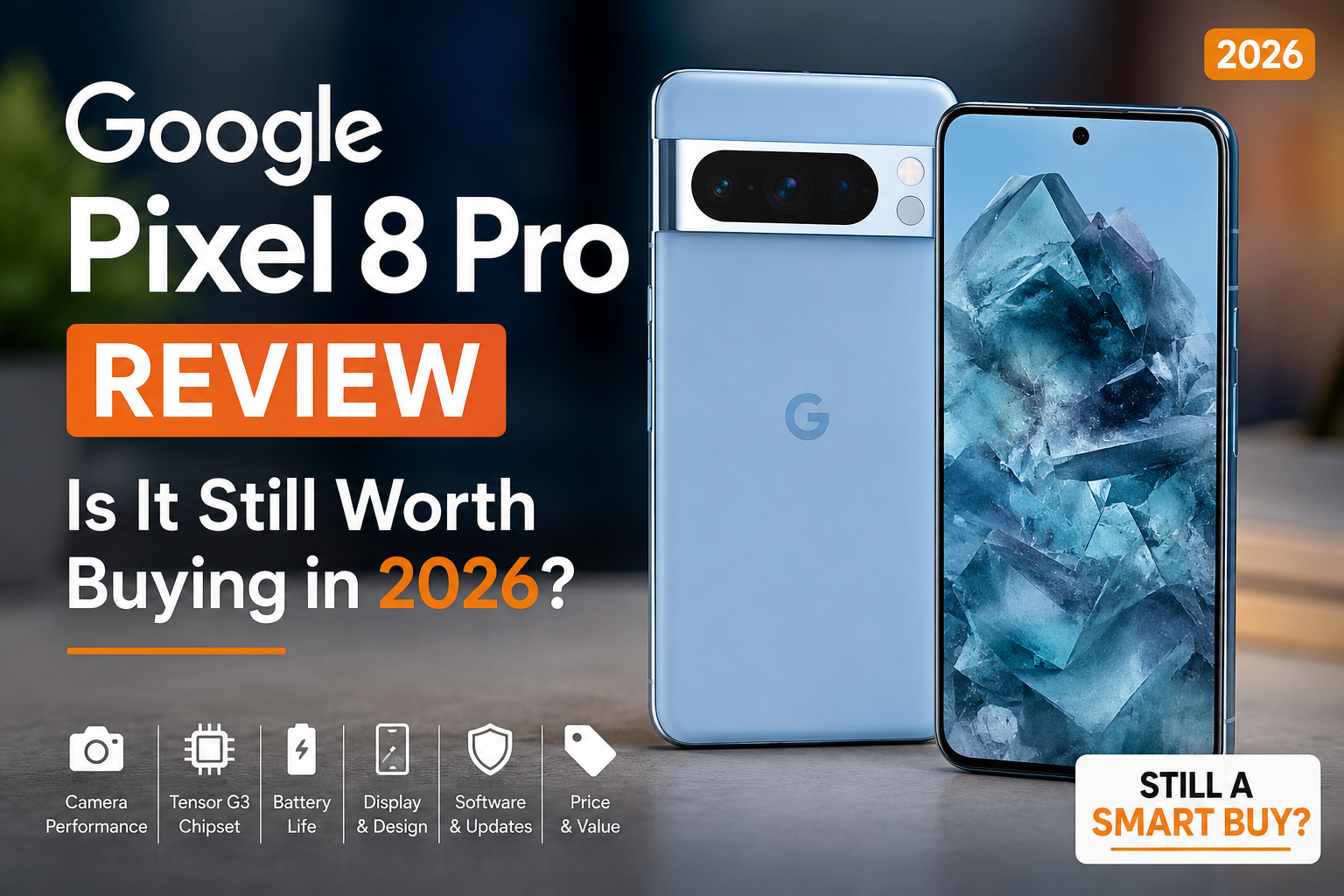
Google Pixel 8 Pro review: The Pixel 8 Pro remains one of Google’s most capable flagship phones, offering an excellent camera system, a stunning 120Hz display and long-term software support..
Powered by Google’s Tensor G3 chipset and equipped with 12GB of RAM, the Pixel 8 Pro delivers smooth everyday performance. Its triple-camera system is even more impressive, combining a 50MP main camera with a 48MP ultrawide and a 48MP telephoto lens with 5x optical zoom.
The bigger question now is value. With newer Pixel phones available, should you still buy the Pixel 8 Pro in 2026?
Let’s take a closer look.
Google Pixel 8 Pro: At a Glance
| 📱 Display | ⚡ Performance |
|---|---|
| 6.7-inch LTPO OLED | Google Tensor G3 |
| 1344 x 2992 resolution | 12GB RAM |
| 120Hz refresh rate | 4nm chipset |
| 📸 Cameras | 🔋 Battery |
|---|---|
| 50MP + 48MP + 48MP | 5,050mAh |
| 5x optical zoom | 30W wired |
| 4K video | 23W wireless |
| 💾 Storage | 💧 Durability |
|---|---|
| 128GB to 1TB | IP68 |
| UFS 3.1 | Gorilla Glass Victus 2 |
| 📅 Release | ⚖️ Size & Weight |
|---|---|
| October 12, 2023 | 213g |
| Android 14 at launch | 162.6 x 76.5 x 8.8mm |
Google Pixel 8 Pro Price and Availability
The Pixel 8 Pro launched as Google’s premium flagship, competing directly with phones such as Samsung’s Galaxy S23 Ultra and Apple’s iPhone 15 Pro Max.
In 2026, the situation is different. The Pixel 8 Pro is an older flagship, which means its biggest appeal is the price.
You can often find older flagship hardware at a significant discount once newer generations arrive. That makes the Pixel 8 Pro interesting for buyers who want flagship-level cameras and a premium display without spending as much as they would on a current flagship.
The phone originally came with four storage options:
| Storage | RAM |
|---|---|
| 128GB | 12GB |
| 256GB | 12GB |
| 512GB | 12GB |
| 1TB | 12GB |
There is no microSD card slot, so choose your storage carefully if you plan to keep the phone for several years.
Google Pixel 8 Pro Review: Design and Display
Google did not completely reinvent the Pixel design with the Pixel 8 Pro. Instead, it refined the distinctive Pixel look.
The horizontal camera bar remains the most recognizable part of the phone. It houses all three rear cameras and gives the device a different appearance from most competing Android phones.
The phone measures 162.6 x 76.5 x 8.8mm and weighs 213g. It is definitely a large phone, and you will notice the weight in your hand.
The build quality, however, feels appropriately premium.
| 🛠️ Build | 📏 Dimensions |
|---|---|
| Gorilla Glass Victus 2 front | 162.6 x 76.5 x 8.8mm |
| Gorilla Glass Victus 2 back | 213g |
| Aluminum frame | IP68 rated |
The Pixel 8 Pro comes in Obsidian, Porcelain, Bay and Mint.
Its IP68 rating also provides protection against dust and water, which is something you expect from a premium flagship.
Google Pixel 8 Pro Display
The 6.7-inch display is one of the Pixel 8 Pro’s biggest strengths.
Google uses an LTPO OLED panel with a 120Hz refresh rate. LTPO technology allows the display to adjust its refresh rate depending on what’s happening on screen, helping balance smoothness and power efficiency.
The resolution is 1344 x 2992 pixels, producing a sharp 489ppi pixel density.
| 🖥️ Display Feature | Specification |
|---|---|
| Panel | LTPO OLED |
| Size | 6.7 inches |
| Resolution | 1344 x 2992 |
| Refresh rate | 120Hz |
| HDR | HDR10+ |
| Peak brightness | Up to 2,400 nits |
| Protection | Gorilla Glass Victus 2 |
Whether you’re watching YouTube, scrolling through social media or reading a webpage, the screen looks sharp and fluid.
The high brightness is also useful outdoors, where cheaper displays can struggle.
Google Pixel 8 Pro Performance
Under the hood, the Pixel 8 Pro uses Google’s Tensor G3 chipset.
It is paired with 12GB of RAM, regardless of which storage configuration you choose.
| ⚙️ Hardware | Specification |
|---|---|
| Chipset | Google Tensor G3 |
| Process | 4nm |
| CPU | Nona-core |
| GPU | Mali-G715 MP7 |
| RAM | 12GB |
| Storage | 128GB to 1TB |
| Storage type | UFS 3.1 |
For everyday use, the Pixel 8 Pro remains fast enough. Apps open quickly, multitasking is smooth and switching between applications feels responsive.
Google’s Tensor chips are particularly focused on AI and machine learning rather than simply chasing benchmark numbers. That approach shows up in several Pixel-exclusive features, especially in photography and voice processing.
However, there is a catch.
The Tensor G3 is now an older flagship chipset. Newer processors can deliver better raw performance and sustained gaming performance.
So while the Pixel 8 Pro is still a good all-rounder, it is not the phone to buy purely for benchmark scores.
Google Pixel 8 Pro Camera System
This is where the Pixel 8 Pro becomes much more interesting.
Google equipped the phone with a triple-camera setup that gives you plenty of flexibility.
| 📸 Camera | Specification |
|---|---|
| Main | 50MP, f/1.7, OIS |
| Telephoto | 48MP, 5x optical zoom, OIS |
| Ultrawide | 48MP, 126° |
| Front | 10.5MP ultrawide |
The 50MP main camera is designed for everyday photography, while Google’s image processing does much of the heavy lifting behind the scenes.
The 48MP telephoto camera adds 5x optical zoom, which is especially useful when photographing distant subjects.
The 48MP ultrawide camera completes the setup, giving you a wider perspective for landscapes, buildings and group photographs.
Pixel 8 Pro Camera Features
Google also packed the Pixel 8 Pro with software-powered photography tools.
| 📷 Feature | What It Does |
|---|---|
| Best Take | Helps create better group photos |
| Zoom Enhance | Improves detail when zooming |
| Ultra HDR | Enhances HDR photography |
| Pixel Shift | Helps improve image detail |
| Laser AF | Assists with focusing |
| Dual-LED flash | Improves low-light illumination |
This combination of hardware and computational photography is a major reason the Pixel 8 Pro remains relevant.
You do not necessarily need to understand photography settings to get good results. The phone handles much of the processing automatically.
Google Pixel 8 Pro Video
The Pixel 8 Pro can record 4K video at up to 60fps.
It also supports slow-motion recording at high frame rates and combines optical and electronic stabilization to help keep footage steady.
| 🎥 Video Feature | Support |
|---|---|
| 4K | 24/30/60fps |
| 1080p | 30/60/120/240fps |
| Stabilization | OIS + gyro-EIS |
| HDR | 10-bit HDR |
For everyday video, travel clips and social media content, the Pixel 8 Pro remains a capable camera phone.
Google Pixel 8 Pro Selfie Camera
The front camera is a 10.5MP ultrawide sensor with autofocus.
The wider field of view makes it useful for group selfies, while autofocus helps keep your face sharp.
It can also record 4K video at up to 60fps.
| 🤳 Selfie Feature | Specification |
|---|---|
| Resolution | 10.5MP |
| Lens | Ultrawide |
| Autofocus | Yes |
| HDR | Yes |
| 4K video | Up to 60fps |
It is not the highest-resolution front camera on the market, but it is more than capable for selfies, video calls and social media.
Google Pixel 8 Pro Battery Life
The Pixel 8 Pro packs a 5,050mAh battery.
That’s a healthy capacity for a phone with a 6.7-inch display, although actual battery life depends heavily on your usage.
Heavy gaming, 5G, high brightness and frequent camera use will naturally consume more power.
| 🔋 Battery Feature | Specification |
|---|---|
| Capacity | 5,050mAh |
| Wired charging | 30W |
| Wireless charging | 23W |
| Reverse wireless | Yes |
| Charging standard | PD 3.0 / PPS |
| Bypass charging | Yes |
Google’s charging speeds are not class-leading in 2026, especially compared with some Android competitors.
Still, the combination of a large battery and wireless charging gives the Pixel 8 Pro good flexibility.
Google Pixel 8 Pro Software
Software has always been one of the strongest reasons to buy a Pixel.
The Pixel 8 Pro launched with Android 14 and can be upgraded to Android 16.
Google’s clean Android interface avoids many of the unnecessary additions found on heavily customized Android skins.
| 🤖 Software | Details |
|---|---|
| Launch OS | Android 14 |
| Current supported OS | Android 16 |
| Major OS updates | Up to 7 |
| Interface | Pixel Android experience |
| AI features | Yes |
The long update commitment is especially valuable in 2026 because it means the Pixel 8 Pro still has meaningful software life ahead of it.
Google Pixel 8 Pro Connectivity
The Pixel 8 Pro supports a wide range of modern connectivity standards.
| 🌐 Connectivity | Support |
|---|---|
| 5G | Yes |
| Wi-Fi | Wi-Fi 7 |
| Bluetooth | 5.3 |
| NFC | Yes |
| USB | USB-C 3.2 |
| GPS | L1 + L5 |
| UWB | Yes |
| 3.5mm headphone jack | No |
| microSD | No |
The lack of expandable storage and a headphone jack will not surprise anyone buying a modern flagship, but they are still worth mentioning.
Google Pixel 8 Pro for Gaming
The Tensor G3 is capable of handling demanding Android games, and 12GB of RAM gives the phone plenty of room for multitasking.
The 120Hz display is another advantage, particularly in games that support higher refresh rates.
However, gaming performance is not the Pixel 8 Pro’s strongest selling point.
Newer flagship chipsets can provide better sustained performance and efficiency, especially during long gaming sessions.
For casual and regular gaming, the Pixel 8 Pro is perfectly capable. Serious mobile gamers should look at newer performance-focused hardware.
Google Pixel 8 Pro Pros and Cons
| 👍 Pros | 👎 Cons |
|---|---|
| Excellent 120Hz OLED display | Tensor G3 is now an older chipset |
| Versatile triple-camera setup | Charging is relatively slow |
| 5x optical zoom | No microSD slot |
| Excellent computational photography | No 3.5mm headphone jack |
| 12GB RAM on every model | Heavy at 213g |
| Long software support | Newer phones offer better performance |
| Premium build quality |
Google Pixel 8 Pro: Key Features
If you are considering the Pixel 8 Pro in 2026, these are the features that matter most:
Excellent Camera Hardware
The combination of a 50MP main camera, 48MP ultrawide and 48MP 5x telephoto gives the Pixel 8 Pro a highly flexible camera system.
Bright 120Hz Display
The 6.7-inch LTPO OLED panel remains one of the phone’s best features, particularly for video, gaming and everyday scrolling.
12GB RAM
Every Pixel 8 Pro configuration comes with 12GB of RAM, so even the base storage model gets flagship-level memory.
Long Software Support
Google’s extended software support gives the Pixel 8 Pro a major advantage over many older Android phones.
Premium Durability
Gorilla Glass Victus 2 and an IP68 rating make the Pixel 8 Pro feel appropriately premium and durable.
Is the Google Pixel 8 Pro Worth Buying in 2026?
The answer largely depends on the price.
If you can find the Pixel 8 Pro at a substantial discount, it remains a compelling smartphone.
Its cameras are still excellent, the display remains flagship-grade and Google’s software experience is one of the cleanest available on Android.
The Tensor G3 is the main area where its age shows. It is capable, but newer flagship processors are faster and more efficient.
The charging speed is another weakness, particularly for users accustomed to much faster Android charging.
But those issues do not erase the strengths of the Pixel 8 Pro.
For someone who prioritizes photography, display quality and software support over raw gaming performance, the Pixel 8 Pro can still make a lot of sense.
Google Pixel 8 Pro vs Newer Flagships
Buying an older flagship always means making a compromise between price and newer hardware.
| 📱 Pixel 8 Pro | 🆕 Newer Flagship |
|---|---|
| Usually cheaper | Usually more expensive |
| Excellent cameras | Newer camera hardware |
| Tensor G3 | Newer, faster processors |
| 120Hz OLED | 120Hz+ OLED |
| Long software support | Longer remaining support |
| Strong everyday performance | Better peak performance |
If price is your priority, the Pixel 8 Pro becomes much more attractive.
If you want the newest processor, fastest charging and latest hardware, a newer flagship is the better choice.
Google Pixel 8 Pro Final Verdict
🏆 Ric Guides Verdict
| ⭐ Ric Guides Rating | 🎯 Best For |
|---|---|
| 4.3/5 | 📸 Photography |
| Still a Great Buy | 🤖 Clean Android |
| 📱 Big Display |
The bottom line: The Google Pixel 8 Pro still delivers excellent cameras, a stunning display and long-term software support. If you find it at the right price in 2026, it’s still a flagship worth considering.
Google Pixel 8 Pro FAQ
Is the Google Pixel 8 Pro still worth buying in 2026?
Yes, especially if you find it at a good discounted price. Its cameras, display and software support remain strong, although newer phones offer faster processors.
How old is the Google Pixel 8 Pro?
The Pixel 8 Pro was announced on October 4, 2023, and released on October 12, 2023.
Does the Pixel 8 Pro support Android 16?
Yes. The Pixel 8 Pro is upgradeable to Android 16.
How good is the Pixel 8 Pro camera?
The Pixel 8 Pro has a 50MP main camera, 48MP ultrawide and 48MP telephoto camera with 5x optical zoom. It remains one of the phone’s strongest features.
Does the Pixel 8 Pro have wireless charging?
Yes. It supports up to 23W wireless charging and reverse wireless charging.
Does the Pixel 8 Pro have a microSD card slot?
No. The Pixel 8 Pro does not support expandable storage through a microSD card.
Is the Pixel 8 Pro waterproof?
It has an IP68 dust and water resistance rating. This provides protection against water exposure under specified conditions, but no phone should be considered completely waterproof.
How much RAM does the Pixel 8 Pro have?
Every storage configuration of the Pixel 8 Pro comes with 12GB of RAM.
Does the Pixel 8 Pro support 5G?
Yes. The Pixel 8 Pro supports 5G connectivity along with Wi-Fi 7 and Bluetooth 5.3.
